Hi, I’m Lisa Reynolds, and welcome to Work From Home Money!
Through the years I’ve worked in many customer service and support roles from home. I know what it’s like to juggle family, work schedules, and technology while trying to build a stable income without ever setting foot in a cubicle.
On this blog, I share:
Honest advice about working from home (the good and the bad).
Tips for finding legitimate remote jobs (no scams, no gimmicks).
Ways to earn and save money while building a flexible lifestyle.
Lessons I’ve learned from my own journey — from seasonal call center gigs to building a dedicated home office.
Whether you’re a stay-at-home parent, someone looking for extra income, or ready to swap your commute for a laptop, I want this blog to be your go-to resource.
Thanks for stopping by — I’m so glad you’re here! Feel free to connect with me, share your own experiences, or drop a question in the comments. Together, we’ll unlock the keys to making money from home.
— Lisa 💻✨
Working from home can blur the lines between “morning routine” and “work mode.” If you’ve ever found yourself scrolling through emails before brushing your teeth — this one’s for you. 😅
Here are a few quick wins that can help you start your day feeling focused, not frazzled:
☕ 1. Wake Up 30 Minutes Before You Log In
Give yourself time to exist before diving into messages and meetings. Use that window for coffee, stretching, or quiet reflection — not Slack notifications.
🗒️ 2. Make a 3-Item Priority List
Skip the mile-long to-do list. Pick the three most important tasks that will move your day forward and focus on those first.
💻 3. Check Your Setup
Before logging in, make sure your headset, Wi-Fi, and login credentials are ready. A two-minute tech check can save you ten minutes of panic later.
🌼 4. Create a “Start Work” Ritual
Light a candle, play instrumental music, or open your blinds. Your brain starts recognizing the ritual as a cue: “Okay, it’s work time.”
❤️ 5. Reward Yourself After the First Hour
Once you’ve made progress on your top tasks, take a five-minute breather. Stretch, refill your coffee, or step outside for a minute. You’ve earned it!
In short: A productive remote morning doesn’t start with chaos — it starts with intention. Small habits, repeated daily, make a big difference over time. 🌅
Practical tips to protect your time, your focus, and your peace of mind while working from home.
Working from home has its perks — no commute, flexible schedules, and the comfort of your own space. But let’s be real: it also comes with challenges, especially when it comes to drawing the line between “home life” and “work life.”
One of the best ways to set yourself up for success is by creating healthy boundaries. Without them, work can bleed into every corner of your day, leaving you drained and unfocused. With them, you can be productive and still protect your personal life.
Define Your Workspace 🖥️
Even if it’s just a desk or a small corner, claim a dedicated spot for work. When you sit down there, your brain knows it’s “go time.” When you leave, you can mentally clock out.
Set Clear Work Hours ⏰
Keep a regular start and stop time, just like you would in an office. Let coworkers (and family) know when you’re available—and when you’re not.
Take Real Breaks ☕
Walking away from the screen isn’t slacking—it’s recharging. Stretch, get fresh air, or enjoy lunch without multitasking. You’ll come back sharper.
Create a Shutdown Ritual 📴
Close your laptop, write out tomorrow’s to-do list, or even light a candle to signal “work is done.” Small rituals help your brain switch gears.
Protect Your Personal Time 💙
Silence work notifications after hours and make time for hobbies, family, or simply doing nothing. Your off-hours should be yours.
Closing
Boundaries aren’t about doing less—they’re about doing better. When you honor your own limits, you not only get more out of your workday, but you also give yourself the gift of a real home life. That balance is where true freedom lives.
Over the years, I worked three seasonal jobs with this company whose name started with a T and ended with a C. My first was way back in 2012 during the holiday rush, doing post-purchase support — and honestly, I loved it!
Fast forward to 2020, during the pandemic, I picked up two more projects. Both were straightforward: looking up information and answering customer questions. But that third project ended up being my last. Looking back, I probably never should have accepted it.
Here’s why:
I had a family emergency come up, and I was constantly trying to get my schedule changed. I was told again and again that it “would get done,” but it never was. Everything at the company at that time felt like total chaos. It wasn’t the same company I remembered it being from 2012.
I was forced to call in a few times back-to-back while still doing everything I could to resolve the schedule issue. Then, just like that, the project ended. Ironically, right after, a recruiter even reached out about a team lead position — but my family situation hadn’t changed, so I had to decline.
For years, I still recommended that company to others. I told people what a great company it was, and I figured one day I’d join another seasonal project. That was the plan… until 2025.
When I applied again, I found out I had been terminated and placed on a no-rehire list. And here’s the part that shocked me most:
👉 The company sometimes puts people on a no-rehire list for 60 days, 3 months, maybe 6 months. But me? My name was there permanently. For life.
And I had no idea — not for months, not for years — that I had been terminated.
I sent email after email, but nothing changed. By that point, it wasn’t even about getting a job anymore — it was about clearing my name. But without proof of all the times I requested schedule changes during a family emergency, I had no way to fight back.
That’s when I learned one of the most important lessons about remote work:
👉 Always document everything.
Save your emails. Save your chat transcripts. Save your schedules. Because one day, you might need to prove what really happened.
In fact, this is exactly why I wrote my blog post Document Everything! — to help others avoid going through what I went through.
In the end, there’s always a silver lining. In a twist of fate that company was both the beginning and the end of my journey with them, but it sparked the creation of WFH Money. And that’s something positive I can carry forward.
💬 Have you ever had a work-from-home job turn out differently than you expected? Share your story in the comments — I’d love to hear it.
✨ And if you want more real talk, lessons, and tips about working from home, subscribe to WFH Money so you don’t miss a post.
Working from home is more popular than ever, and that means opportunities are everywhere. Unfortunately, so are scams. For every legitimate remote job, there’s a fake posting waiting to steal your time, money, or personal information.
If you’re just starting your work-from-home journey, here’s a practical guide to spotting scams and finding legit jobs.
🚩 Red Flags of Remote Job Scams
They Demand Money With No Clear Return In most traditional jobs, you should never have to pay to get hired. Be careful of listings that ask for large fees for “starter kits” or “access to jobs.” 👉 Note: Some independent contractor platforms (like Arise or LiveOps) do charge for certification or training. This isn’t automatically a scam — but you should research the company, understand exactly what you’re paying for, and decide if it makes sense for your career goals.
The Pay Sounds Too Good to Be True If a posting promises $2,000 a week for simple tasks like stuffing envelopes or basic data entry, it’s likely a scam. Real jobs pay fairly, but not unbelievably.
Vague Job Descriptions Watch out for listings with little detail about the role, responsibilities, or company background. A lack of transparency is a big warning sign.
Unprofessional Communication Emails full of typos, no company email address (like Gmail or Yahoo instead), or recruiters who dodge your questions are red flags.
Pressure to Act Quickly Scammers push you to “sign up now” or “secure your spot immediately.” A real employer gives you time to think.
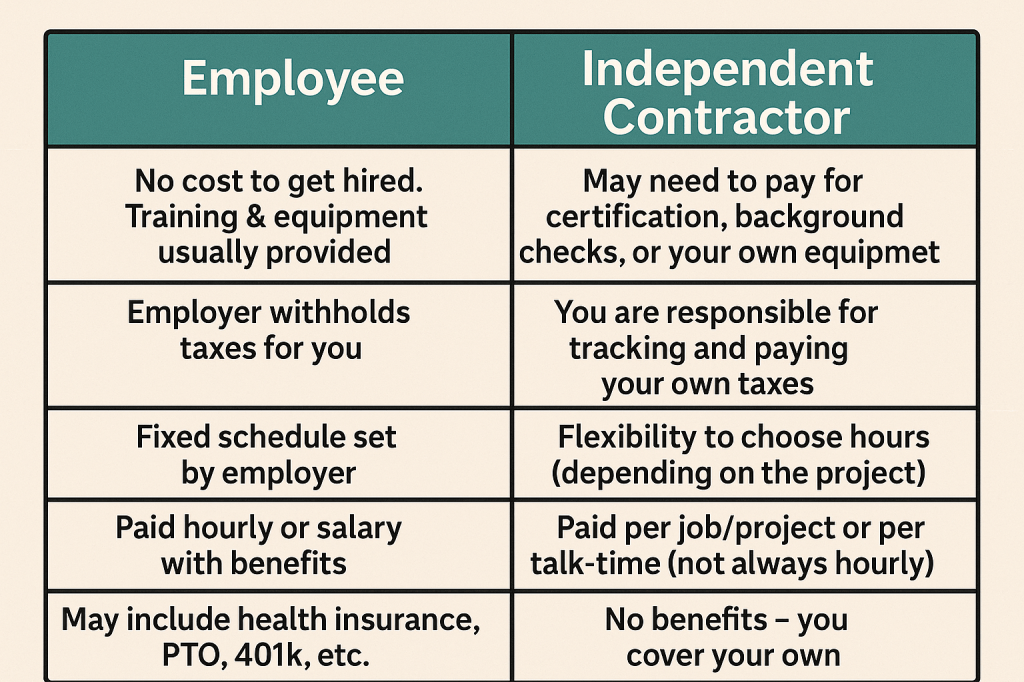
📊 Employee vs. Independent Contractor: What’s the Difference?
Aspect
Employee
Independent Contractor
Upfront Costs
No cost to get hired. Training & equipment usually provided.
May need to pay for certification, background checks, or your own equipment.
Taxes
Employer withholds taxes for you.
You are responsible for tracking and paying your own taxes.
Schedule
Fixed schedule set by employer.
Flexibility to choose hours (depending on the project).
Pay Structure
Paid hourly or salary with benefits.
Paid per job/project or per talk-time (not always hourly).
Benefits
May include health insurance, PTO, 401k, etc.
No benefits — you cover your own.
✅ How to Find Legit Remote Jobs
Research the Company Google their name + “scam” or “reviews.” Check LinkedIn to see if the company and employees are real.
Use Trusted Job Boards Stick with sites like FlexJobs, Indeed, Remote.co, and LinkedIn. Many companies also post directly on their own careers page.
Ask Questions Legit employers will answer questions about pay, training, equipment, and schedules. Scammers avoid details.
Trust Your Gut If something feels “off,” it probably is. Don’t ignore those instincts.
🌟 Final Thoughts
Remote work is full of amazing opportunities — but staying safe is part of the job hunt. Protect your personal info, keep an eye out for red flags, and learn the difference between legit contract work and scam tactics.
With a little caution, you can avoid scams and land the real work-from-home job you deserve.
Working from home has its perks — no commute, flexible schedules, and the comfort of your own space. But let’s be real: it also comes with challenges, especially when it comes to drawing the line between “home life” and “work life.”
One of the best ways to set yourself up for success is by creating boundaries — both physical and mental — that protect your focus and professionalism.
Set Up a Dedicated Workspace
Yes, you can technically work from the couch, kitchen table, or even your bed. But if possible, set aside a room (or at least a quiet corner) that serves as your official home office.
If you have kids or family members at home, having a room with a door is a game-changer. Nothing derails your concentration faster than worrying about whether background noise will carry through when you take your phone off mute. A private workspace allows you to focus fully on your customers without distractions.
Protect Privacy and Professionalism
Another key reason for a private office? Security.
If your job involves handling sensitive information like credit card numbers, customer addresses, or account details, you need to ensure confidentiality. Customers would never feel comfortable knowing their data could be overheard by family members or seen by someone wandering through the house.
Having a separate, closed-off workspace shows that you take privacy seriously — and that’s not just professional, it’s ethical.
Build Mental Boundaries Too
Physical space is important, but so is your mindset. When you walk into your workspace, treat it like you’re “at the office.” And when you shut the door at the end of the day, leave work behind.
This separation helps you avoid burnout and keeps your family time sacred.
✨ Final Tip: Creating boundaries doesn’t mean shutting out your loved ones — it means carving out a balance where you can give 100% to your work when needed, and then step back into your personal life fully present.
If you enjoy writing, you might be sitting on a goldmine without even realizing it. Blogging isn’t just a creative outlet — it’s one of the most popular ways to make money from home. With the right strategy, your words can turn into steady income streams.
Why Blogging Works
Blogs are powerful because people are constantly searching online for advice, inspiration, and solutions. If you can share your knowledge, experiences, or talents in a way that helps others, you can build an audience that keeps coming back. And once you have readers, you can monetize.
Ways to Earn Money Blogging
Here are a few of the most common (and beginner-friendly) methods:
Affiliate Marketing 🛒 Recommend products you love and include your affiliate links (like Amazon Associates). Every time someone buys through your link, you earn a commission.
Sponsored Posts ✨ Companies may pay you to write about their product or service once your blog has some traffic.
Ads 📢 By joining programs like Google AdSense, you can earn money whenever readers see or click ads on your blog.
Digital Products 📚 Create and sell eBooks, guides, or printables. This is perfect if you’re already good at organizing knowledge.
Donations & Support ☕ Platforms like Buy Me a Coffee let your readers support your work directly.
Getting Started
The best part? You don’t need to be a professional writer to start. Write the way you talk, keep your content useful, and stay consistent. Choose a topic you’re passionate about — whether it’s remote work, customer service, crafts, or lifestyle tips.
Final Thoughts
If you have a talent for writing, blogging is one of the most creative and flexible ways to make money from home. It won’t happen overnight, but with persistence, your blog can grow into both a passion project and an income source.
🎥 Thinking about starting your own blog or YouTube channel? The Movo USB-C Vlogging Kit for iPhone 15 is an all-in-one starter kit with a tripod, LED light, and microphone — everything you need to create quality content from home. 👉 [Check it out on Amazon]https://amzn.to/48Fe5Ni
“Why the Holidays Are the Best Time to Land a Work-From-Home Job”
One of the fastest ways to make money from home is by working in remote customer service. You might be surprised at how quickly you can get hired—especially at the right time of year.
Why the Holidays Are Hiring Season
A couple of months before Christmas, many companies that hire remote customer service workers are on the lookout for people seeking work from home opportunities. The holiday season is one of the busiest times of the year. Phones ring faster than Santa’s bells, and companies know they’ll need extra help to keep up with the rush.
That’s why they start hiring large numbers of seasonal employees—people who can step in, step up, and save the day.
Don’t Overlook Seasonal Jobs
It might be tempting to pass over seasonal job offers because they sound “temporary.” But don’t dismiss them too quickly. Seasonal positions can often lead to long-term opportunities once the busy season is over. Even if they don’t, they’re still a fantastic way to:
Make money from home quickly.
Gain new skills and experience for your resume.
Test the waters with a company before applying for something permanent.
A Win-Win Situation
If you’re looking for some extra cash to spend on Christmas gifts 🎁, a seasonal job could be just the answer. You’ll not only earn money for the holidays but also get your foot in the door with companies that may keep you on afterward.
Bottom line: Seasonal customer service work is one of the easiest ways to make money from home right now. Keep an eye out for opportunities starting in the fall, and you could be working from your home office just in time for the holiday rush.
💻 Need a reliable laptop for working from home? The Acer Aspire 5 15.6″ Touchscreen Laptop with Intel Core i5, 8GB RAM, and 512GB SSD is a great balance of power and price. Fast enough to handle customer service platforms, video calls, and multitasking — all while keeping things lightweight and easy to use. 👉 [Check it out on Amazon]https://amzn.to/3IOKuX7
Hi, I’m Lisa, and I started this blog to share what I’ve learned (the good, the bad, and the funny) about working from home.
Why I Started This Blog
Working from home sounds like a dream — no commute, no rushing out the door, and coffee refills on your own schedule. But the truth is, it comes with its own challenges, from tough customer calls to strict schedules.
I’ve been through the ups and downs, and I want to pass along what I’ve learned so others can work smarter (and maybe a little happier) from home.
What You’ll Find Here
If you’re looking for: 💻 Real tips for landing and keeping remote jobs 📈 Ways to make extra money right from your home office 📂 Advice on handling schedules, customers, and stress ☕ A little encouragement when the coffee wears off…
…then you’re in the right place!
Let’s Do This Together
Take a look around, check out the latest posts, and feel free to leave a comment or share your own work-from-home stories. We’re all in this together.
Thanks for stopping by — I hope you find something here that helps you on your WFH journey.
Make money at home with these flexible ideas — from steady remote jobs to side hustles you control.
Working from home isn’t just about convenience anymore — it’s about real opportunity. More and more people are asking the same question: “How can I make money at home?” The good news is that your home office can become the launchpad for flexible work, steady income, and even creative side hustles. Whether you want a stable paycheck, a little extra on the side, or the freedom to build something of your own, here are 20 tried-and-true ways to make money without ever leaving the house.
💻 Customer Service & Support
Remote Customer Service Representative – Work for companies like TTEC, Concentrix, or Amazon handling calls, chats, or emails.
Quality Assurance Monitoring – Listen to and score customer service calls for accuracy and professionalism.
Virtual Call Center Independent Contractor – Partner with companies like LiveOps or Arise where you can set your own hours.
✍️ Writing & Content
Freelance Writing – Write articles, blogs, or web copy for businesses and earn money per project.
Proofreading & Editing – Clean up other people’s writing for clarity and style.
Transcription – Turn podcasts, videos, or legal/medical recordings into text.
Blogging – Just like I’m doing here at WFH Money 💻☕ — share your expertise, grow your audience, and monetize through ads, affiliate links, and donations.
📊 Administrative & Business Support
Virtual Assistant (VA) – Help business owners manage email, scheduling, or social media.
Online Data Entry – Enter info into spreadsheets, databases, or CRMs from home.
Bookkeeping – Manage finances for small businesses (with some training).
🎨 Creative & Digital Work
Graphic Design – Create logos, flyers, or social media graphics from your laptop.
Selling Digital Products – E-books, templates, or printables can bring in passive income.
Online Course Creation – Teach something you know through Zoom, Teachable, or Udemy.
📦 Product-Based Income
Etsy Shop – Sell crafts or handmade goods like candles, jewelry, or t-shirts.
Dropshipping – Sell products online without holding inventory.
Print-on-Demand – Put your designs on T-shirts, mugs, or notebooks with no upfront costs.
🎥 Sharing Your Voice & Skills
YouTube Channel – Create helpful or entertaining videos and earn through ads and sponsorships.
Podcasting – Share your voice, land sponsorships, or receive listener donations.
Tutoring or Teaching Online – Help students with math, English, or test prep from your home office.
🗝️ Flexible / Side Hustles
Online Surveys & Market Research – Use sites like Swagbucks, UserTesting, or focus groups for extra pocket money.
Final Thoughts
Making money at home isn’t just a dream — it’s reality for millions of people every day. Whether you’re after a traditional remote job or a creative side hustle, your home office can become your money-making hub. Start small, try a few of these ideas, and see what sticks. With consistency and effort, you’ll be surprised at how much you can accomplish (and earn) without ever leaving your house.
☕ People often assume working from home means total freedom with your time. Roll out of bed at noon? Sure. Work in your pajamas? Absolutely. Clock in only when you feel like it? Not so fast.
The truth is: how much freedom you really have depends on how you’re working from home — whether you’re an employee or an independent contractor. I’ve worked under both setups, and let me tell you, they are very different experiences.
Let’s break it down.
👩💻 Working From Home as an Employee
Think of this as the more “traditional” way of working — just without the commute.
✅ The Pros
You’re paid by the hour, no guessing games.
Benefits like health insurance, PTO, or retirement may be included (depending on the company).
Taxes are automatically withheld — you don’t have to set anything aside or stress during tax season.
⚠️ The Cons
You usually have a strict schedule. Clock in and clock out times are non-negotiable.
You answer to a boss or team lead, just like you would in an office.
If you’re not logged in and available, you’re not getting paid.
🛠️ Working From Home as an Independent Contractor
This setup offers more flexibility, but also more responsibility.
✅ The Pros
You can often set your own hours and choose your projects.
You’re paid by the job or task, so the more you complete, the more you can earn.
You are your own boss — no supervisor watching over your shoulder.
⚠️ The Cons
No company benefits — you’re on your own for health insurance, retirement, and time off.
You’re not guaranteed hourly pay. If the phones are quiet or work is slow, you’re not making money.
Taxes aren’t withheld — you have to budget and set money aside for the IRS.
🔑 The Bottom Line
Neither option is “better” than the other — it depends on you.
If you love structure, security, and benefits → an employee role might be your best fit.
If you value freedom, flexibility, and being your own boss → an independent contractor role might make more sense.
At the end of the day, working from home isn’t one-size-fits-all. Knowing the differences helps you pick the path that works best for your lifestyle, goals, and family.
✨ Have you worked as both an employee and a contractor? Drop a comment — I’d love to hear your experience!














 WFH Money